
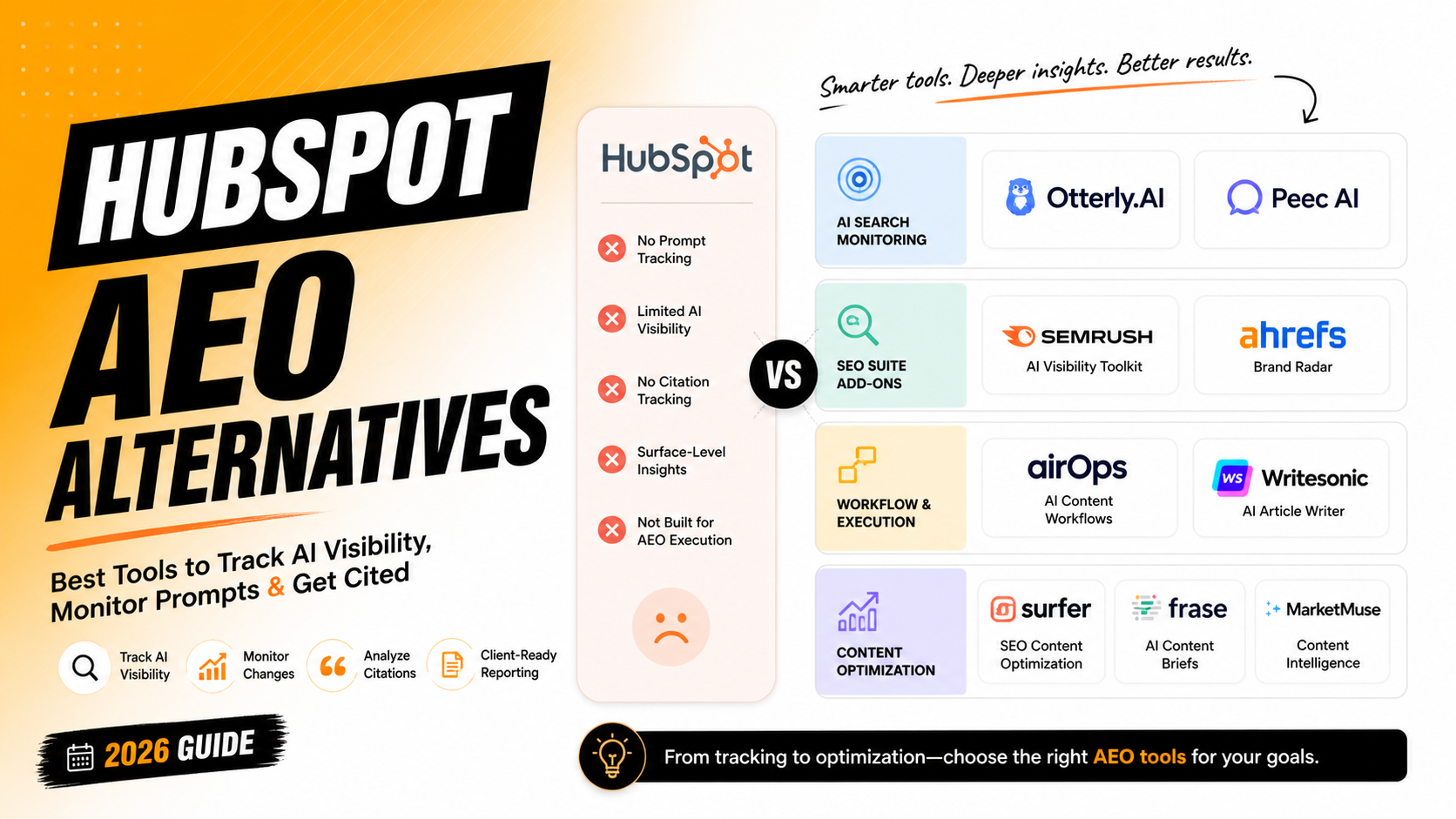
HubSpot AEO is a solid “first read” on whether your site is showing up in AI answers, but most teams outgrow a snapshot-style grader once they need query-level tracking over time.
If you are using HubSpot AEO (or the HubSpot AEO Grader) and want deeper AI search visibility tracking across ChatGPT, Perplexity, and Google AI Overviews, the right alternative depends on one thing: whether you need monitoring, optimization, or proof of business impact (citations/inclusion tied to leads, calls, or bookings).
What HubSpot AEO Is (And Why Teams Look for Alternatives)
HubSpot AEO is designed to give marketers a snapshot-style audit of answer engine optimization readiness.
The HubSpot AEO Grader typically focuses on basic AI visibility signals and guidance, similar to an “SEO grader” experience but aimed at AEO concepts.
AEO tools vary a lot in what they actually do.
Some are built for monitoring AI answers over time with prompt tracking and change detection, while others focus on content optimization, content briefs, or PR-style brand mentions and share of voice reporting.
Teams usually start looking for alternatives when they need more than a grade.
The most common reasons are deeper citation tracking, continuous monitoring, multi-brand or multi-location reporting, and clearer ROI attribution tied to leads, bookings, or calls.
Quick Definition: AEO vs SEO vs GEO
Answer engine optimization is about getting selected as the answer inside AI interfaces, not just ranking in the blue-link SERP.
That includes ChatGPT, Perplexity, Microsoft Copilot, and Google AI Overviews, where the user may never click a traditional result.
SEO still matters because AI Overviews and other AI systems may draw from pages that are already visible and trusted in traditional search.
Technical SEO, crawlability, internal linking, and structured data can directly affect whether your content is easy to extract and trust.
Generative engine optimization (GEO) overlaps heavily with AEO.
GEO usually emphasizes LLM citations, brand mentions, and inclusion in generated answers across multiple models, especially when citations are inconsistent or missing.
Who This Comparison Is For
This comparison is for marketing teams that need AI visibility reporting they can act on, not just a one-time score.
It is also for SaaS and B2B teams that want to connect query coverage to lead quality and conversion tracking.
It is a strong fit for agencies and multi-location businesses that need repeatable workflows.
Client-ready reporting, exports, and multi-location reporting matter a lot when you are accountable for outcomes across many service pages and location pages.
How We’re Comparing HubSpot AEO Alternatives (So You Can Choose Fast)
Start with the use case, not the feature list.
Most buyers fall into one primary bucket: monitoring AI visibility, improving content for AI answers, doing brand and citation research, or building workflow automation for repeatable AEO/GEO operations.
Then evaluate tools on criteria that actually change decisions.
Coverage across ChatGPT, Perplexity, Google AI Overviews, and Microsoft Copilot matters, but citation detail, reporting, exports, integrations, team collaboration, and prompt reproducibility controls (location, model/version, and settings) usually matter more once you are operational.
Practical constraints decide what sticks.
Pricing model, seats, data freshness, and multi-location support can kill adoption even if the product demos well.
Key Features That Actually Matter
Citation and source tracking is the difference between “we think we improved” and “we can prove it.”
You want to see which domains get cited, how often they appear, and which prompts or queries trigger those citations.
Change detection prevents silent losses.
Strong AEO software should alert you when your brand appears or disappears in AI answers, when citations shift to a competitor, or when the answer changes enough that your page no longer fits—based on consistent prompt runs and clear change thresholds.
Red Flags to Watch For
Vanity scoring is the biggest trap.
If a tool cannot show query-level evidence with reproducible prompts, you will struggle to justify work internally or to clients.
Weak exports and reporting become a bottleneck fast.
If you cannot segment by location, service line, product, or intent cluster, multi-location brands and agencies end up rebuilding dashboards manually.
Best HubSpot AEO Alternatives (By Use Case)
Most teams shop for AEO tools based on how work gets done, not on who has the flashiest feature checklist.
Below is a curated shortlist that matches real buying patterns: agency workflows, enterprise depth, SEO suite add-ons, AI monitoring specialists, and automation for ops-heavy teams.
A quick note on positioning.
Some tools are purpose-built for AI visibility monitoring, while others are supportive for AEO because they improve the underlying content and technical signals that LLM systems rely on.
Agency-Friendly Options
Agency teams usually need three things: repeatable prompt sets, client-ready reporting, and clear before-and-after evidence.
That evidence can be citation shifts, inclusion rate changes, and expanded query coverage across a service category.
Rankability
Rankability is one of the most agency-aligned alternatives to HubSpot AEO because it is built around execution workflows, not just scoring.
It is especially useful when you need to turn observations into repeatable deliverables, like updating priority pages, improving direct answers, and shipping content changes across multiple clients.
Rankability also tends to fit how agencies sell and retain.
You can structure prompt libraries around client industries, build prompt tracking into monthly reporting, and show progress without forcing clients to interpret abstract metrics.
If you want an easy way to evaluate it, create a short pilot workspace and track 20 to 30 prompts per client.
Keep prompts consistent across brand, non-brand, and “best” queries, then tie improvements back to conversions where possible.
Internal link suggestion: If you already have a process for page updates, pair Rankability with a clear content refresh workflow and a technical SEO checklist so wins compound.
SE Ranking
SE Ranking is a cost-conscious suite for teams that want broader SEO and reporting alongside AI visibility efforts.
It is often chosen by smaller agencies or in-house teams that do not want to pay for multiple point solutions.
The value here is coverage beyond AEO.
If you still need rank tracking, site audits, competitor tracking, and reporting in one place, SE Ranking can reduce tool sprawl while you build an AEO practice.
Enterprise AI Visibility Depth
Enterprise teams care less about “does my homepage show up” and more about governance.
They need segmentation by region and product line, repeatable measurement across hundreds or thousands of prompts, and the ability to explain why visibility changed.
Profound
Profound is positioned for deeper enterprise-grade AI visibility analysis.
It is a better fit when you have a complex topic portfolio, multiple stakeholders, and a need to operationalize findings across content, PR, and product marketing.
Enterprise AEO is often about pattern detection.
Profound-style tooling is useful when you need to see which entities, topics, and cited sources correlate with inclusion, then prioritize the pages and knowledge assets that move the needle.
Meltwater
Meltwater comes at the problem from a PR and brand intelligence angle.
It is not an AEO tool in the narrow “prompt tracking” sense, but it can support AI answer inclusion by showing where brand mentions are growing or shrinking across the web.
This matters because many AI systems are influenced by what’s widely published and referenced on the web, and they often surface sources that appear authoritative.
If your strategy includes digital PR, executive thought leadership, or reputation management, Meltwater can provide the monitoring layer that complements on-site optimization.
If You’re Already in an SEO Suite
If your team already lives inside an SEO platform, an add-on can be the fastest path to adoption.
You get shared reporting, existing user seats, and a workflow your team already understands.
Semrush AI Visibility Toolkit
Semrush AI Visibility Toolkit is usually the best fit when Semrush is already your system of record.
That matters because AEO does not replace SEO; it rides on top of it, especially for content planning, competitive analysis, and measuring SERP movement alongside AI Overviews.
The advantage is operational.
You can connect keyword research and content briefs to AI visibility tracking, then prioritize updates where both the SERP and AI answers show opportunity.
Ahrefs Brand Radar
Ahrefs Brand Radar is strong for brand visibility research and cited-domain analysis.
It helps teams understand which publishers and domains AI systems lean on, which is often the missing link in “why does my competitor show up instead of us?”
Ahrefs is also useful for competitive analysis beyond AI answers.
If you are building authority, improving citations, and deciding where to earn links or mentions, Ahrefs data can inform the PR and content strategy that supports GEO outcomes.
AI Search Monitoring Specialists
Monitoring specialists are the closest “category match” to what most people want when they search for alternatives to HubSpot AEO.
They focus on prompt tracking, change detection, alerts, and reporting over time.
Otterly.AI
Otterly.AI is a monitoring-focused option for tracking AI search visibility changes over time.
It is a good fit if your primary need is to know when you are included, when you drop, and what the answer looks like across a defined prompt set.
This is where change detection earns its keep.
If Google AI Overviews or Perplexity shifts its citations, you can catch it early and update the page that used to be cited.
Peec AI
Peec AI focuses on monitoring and reporting for brand presence in AI answers.
It is often evaluated by teams that want something more operational than a grader, especially when multiple stakeholders need a shared view of progress.
Peec AI is most valuable when you standardize prompts by intent.
For example, separate “buying” prompts from “how-to” prompts, then report on inclusion rate and cited sources for each cluster.
LLMrefs
LLMrefs is commonly discussed in the context of tracking LLM citations and references.
If your main pain is “we do not know where AI tools are getting their sources,” LLMrefs-style tooling can help you map patterns and identify which pages need to become more cite-worthy.
Treat it as a research layer.
Pair it with on-site improvements like schema markup and stronger internal linking so the pages you want cited are easy to parse and clearly authoritative.
Scrunch
Scrunch is another name that comes up in AI visibility monitoring conversations.
Depending on your needs, tools in this category can be useful for prompt tracking, competitor tracking, and reporting that shows share of voice inside AI answers rather than only in the SERP.
The key evaluation question is simple.
Can you export query-level data, and can you reproduce the same prompt runs over time to prove change?
xSeek and Atomic AGI
xSeek and Atomic AGI are often evaluated by teams experimenting with automation-heavy approaches to AI search workflows.
They can be relevant if you want to connect monitoring outputs to automated actions, like generating content briefs, drafting updates, or pushing tasks into project management.
Use caution with automation-first stacks.
If the underlying measurement is weak, you can scale the wrong work faster.
Automation and Ops (For Teams That Need Workflows)
Some teams do not need another dashboard.
They need a system that turns prompts, data, and content into a repeatable production line with approvals, QA, and publishing steps.
AirOps
AirOps is built for connecting prompts, data sources, and content workflows.
For AEO and GEO, it is useful when you want to operationalize tasks like generating content briefs, rewriting sections into direct answers, or creating FAQ blocks aligned to prompt clusters.
AirOps becomes more valuable when paired with monitoring.
The monitoring tool tells you what changed, and AirOps helps you ship the response consistently across many pages.
Writesonic
Writesonic is an AI writing workflow tool that can support AEO content production.
It is best treated as a drafting and iteration layer, not as the measurement system itself.
If you use Writesonic, pair it with a monitoring tool like Otterly.AI or Peec AI.
That pairing prevents the common failure mode of producing lots of content without knowing whether AI answers are actually citing or selecting it.
Supportive Content Optimization Platforms (Not Pure AEO)
Tools like Surfer, Clearscope, Frase, and MarketMuse are not primarily AEO monitoring platforms.
They can still matter because content optimization affects how well pages answer questions, how comprehensively they cover entities, and how likely they are to be used as a source.
Surfer
Surfer helps tune on-page content based on SERP patterns and competitor pages.
It is helpful when you need to expand topical coverage, add missing subtopics, or structure content in a way that better matches query intent.
Clearscope
Clearscope is often used for editorial-grade content optimization.
It can be valuable for improving clarity and coverage, which matters when AI systems extract short, direct answers from longer pages.
Frase
Frase is strong for research and content briefs.
If your bottleneck is creating briefs that map to prompt clusters and questions users ask in AI tools, Frase can speed up planning.
MarketMuse
MarketMuse focuses on topic modeling and content planning.
It can be useful for building authority across a topic cluster, which supports both SEO and GEO outcomes over time.
Local Reputation and Multi-Location Supportive Tools
Not every AI visibility win is purely “on-site content.”
Local SEO signals, reviews, and citations can influence what AI systems recommend for “best plumber near me” or “top-rated dentist in Summerlin.”
Birdeye
Birdeye is widely used for reviews and reputation management.
Reviews are not just a conversion lever; they can also act as a credibility signal that may influence AI-generated local recommendations.
If you are a multi-location brand, Birdeye-style tooling can help standardize review generation and respond faster.
That improves trust signals that AI systems may reference indirectly through sources they cite.
Feature Comparison Table: HubSpot AEO vs Leading Alternatives
HubSpot AEO is an easy entry point for marketers who want a quick read.
Most alternatives win on depth, continuous monitoring, and enterprise-ready reporting.
Tool Comparison
AEO Platforms at a Glance
A side-by-side look at how the leading Answer Engine Optimization tools stack up across coverage, citation tracking, alerts, reporting, and more.
Tool
Coverage
ChatGPT, Perplexity, AI Overviews, Copilot
Citation / Source Tracking
Prompt Library & Tracking
Alerts & Change Detection
Reporting / Exports
Integrations / API
Multi-Location Reporting
Pricing Transparency
Best For
HubSpot AEO + AEO GraderLimited, varies by featureBasic signals, often not query-deepLimitedLimitedBasicHubSpot ecosystemLimitedGenerally clearQuick snapshot and beginner guidance
RankabilityVaries by planStrong for operational workflowsStrongModerate to strongStrong client-ready outputsVariesStrong for agenciesUsually clearAgencies needing repeatable AEO deliverables
SE RankingPrimarily SEO suite, AI features varyLimited to moderateLimited to moderateLimitedStrong SEO reportingIntegrations varyModerateClearBudget-friendly SEO suite plus reporting
ProfoundEnterprise-focused coverageDeep analysisStrongStrongEnterprise-gradeAPI / SSO more likelyStrongLess transparentEnterprises with large topic portfolios
MeltwaterIndirect AEO supportMentions-focusedNot coreStrong media monitoring alertsStrongStrong integrationsStrongLess transparentPR-driven brand mention strategy
Semrush AI Visibility ToolkitStrong if in Semrush ecosystemModerate to strongModerateModerateStrongStrongModerateClearTeams already standardized on Semrush
Ahrefs Brand RadarResearch-orientedStrong cited-domain analysisNot coreLimitedStrong exportsAPI availableModerateClearCompetitive research and authority building
Otterly.AIMonitoring-focusedStrongStrongStrongGoodLimitedModerateClearAI answer monitoring and change tracking
Peec AIMonitoring-focusedStrongStrongStrongStrongVariesModerate to strongVariesReporting for brand presence in AI answers
LLMrefsLLM citation researchStrongModerateModerateModerateVariesModerateVariesUnderstanding where LLM citations come from
ScrunchMonitoring and reportingModerate to strongModerateModerateModerateVariesModerateVariesShare of voice and competitor tracking in AI answers
AirOpsWorkflow automationNot coreStrongNot coreExports varyStrongStrongClearTurning prompts into repeatable content ops
WritesonicContent productionNot coreModerateNot coreModerateIntegrations varyLimitedClearDrafting and scaling content updates
Scroll horizontally to view all columns. Capabilities reflect general positioning and may vary by plan tier.
Which Tool Should You Choose? (Decision Guide by Team Type)
Tool choice gets easier when you map it to the business context.
A local service business needs different reporting than an agency, and an enterprise team needs governance and segmentation that smaller teams will never use.
Run a 14 to 30 day pilot instead of debating features, with a fixed prompt set (by intent and location), a baseline export/screenshot, and a clear success metric like inclusion rate or citation gains on revenue pages.
Set a baseline prompt set, track citations and inclusion rate, ship 3 to 5 content fixes, then measure movement in AI answers and conversions.
Most teams end up combining tools.
A common stack is monitoring plus content optimization plus technical SEO, because the monitoring layer tells you where you are losing and the execution layer fixes why.
Local Businesses: What Matters Most
Local AEO is mostly about service plus city prompts.
Think “best HVAC repair in Las Vegas” or “emergency electrician near Henderson,” where AI tools pull from Google Business Profile data, reviews, and authoritative local sources.
Prioritize reputation and consistency.
NAP consistency, citations across listings, and review velocity can matter as much as on-page text for local recommendations.
Choose tools with simple reporting and alerts.
Avoid enterprise complexity if you will not use segmentation, APIs, or advanced governance features.
If you want a practical workflow, build location pages that answer “cost,” “time,” “availability,” “warranty,” and “service area” questions directly.
Then add schema markup and structured data so those answers are easy to extract.
Agencies: What Matters Most
Agencies win when they can show proof.
Client-ready exports, multi-client workspaces, and repeatable prompt sets are what turn AEO from an experiment into a service line.
Prioritize “before/after” evidence.
Track inclusion rate, citation shifts, and query coverage by category, then connect the work to conversion tracking where possible.
Rankability is usually a strong starting point for agencies because it aligns to workflows and deliverables.
It also makes it easier to standardize prompt libraries by niche, which reduces onboarding time for each new client.
Enterprise Teams: What Matters Most
Enterprise AEO is a data and governance problem.
You need segmentation by product line, region, and intent cluster, plus consistent measurement across time and teams.
Security and access controls matter.
Look for SSO, role-based access, and API access where available, especially if you plan to pipe data into a BI tool.
Profound is often evaluated here because it is oriented toward deep analysis.
Pair it with a technical SEO program that covers crawlability, internal linking, and Core Web Vitals so content improvements are not blocked by site performance.
How to Get Better AI Visibility Without Chasing Scores
AEO is less about scoring and more about being the most citable, extractable answer.
AI systems reward pages that are clear, structured, and consistent with other trusted sources.
Start with the pages that already convert.
Improving AI visibility for a low-value blog post feels good, but improving visibility for a high-intent service page changes revenue.
Build Pages That AI Can Extract Cleanly
Write direct answers near the top of the page.
A two to three sentence definition, a short “when to choose this” section, and a clear list of steps often get reused in AI answers.
Use structured formatting.
Add FAQ blocks, comparison tables, and short sections with descriptive headings so the content is easy to parse.
Strengthen Technical Signals That Support Trust
Technical SEO still decides whether your content is accessible.
Crawlability, internal linking, page speed, and Core Web Vitals influence whether your pages are reliably discovered and rendered.
Add schema markup where it fits.
Structured data like FAQ, LocalBusiness, Product, Review, and Service schema can help clarify entities and relationships, even if AI tools do not always cite schema directly.
Improve Entity Coverage and Consistency
LLM systems respond well to consistent entity signals.
Make sure your brand, products, services, and locations are described the same way across your site, your Google Business Profile, and major citations.
This is where multi-location brands often struggle.
If one location page uses different service naming, different phone numbers, or inconsistent NAP data, AI tools can pick up the inconsistency and default to a competitor.
Verdict: The Right HubSpot AEO Alternative Depends on Your Goal
If you want the easiest starting point, HubSpot AEO is fine for a quick snapshot.
If you want ongoing monitoring and change detection, Otterly.AI and Peec AI are closer to what most teams need day to day.
If you need enterprise depth, governance, and segmentation, Profound is the type of platform to evaluate.
If you already run your SEO program inside a suite, Semrush AI Visibility Toolkit or Ahrefs Brand Radar can reduce friction and keep reporting centralized.
If you are an agency that needs repeatable workflows and client-ready outputs, we’d treat Rankability as the most straightforward upgrade path from a grader-style tool because it supports prompt libraries, reporting, and repeatable execution.
It supports prompt libraries, operational execution, and proof that clients can understand.
Suggested Next Step Checklist
- Baseline 20 to 50 prompts across service, brand, competitor, and “best” queries.
- Track inclusion rate, citations, and cited-domain analysis for each prompt cluster.
- Fix the top 5 pages tied to revenue: add direct answers, strengthen internal linking, implement schema markup and structured data, and improve page speed.
- Re-run the same prompt tracking weekly for 30 days and document change detection events with screenshots.
- Connect wins to ROI attribution using conversion tracking for forms, calls, and bookings, then prioritize the next batch of pages based on lead quality.