
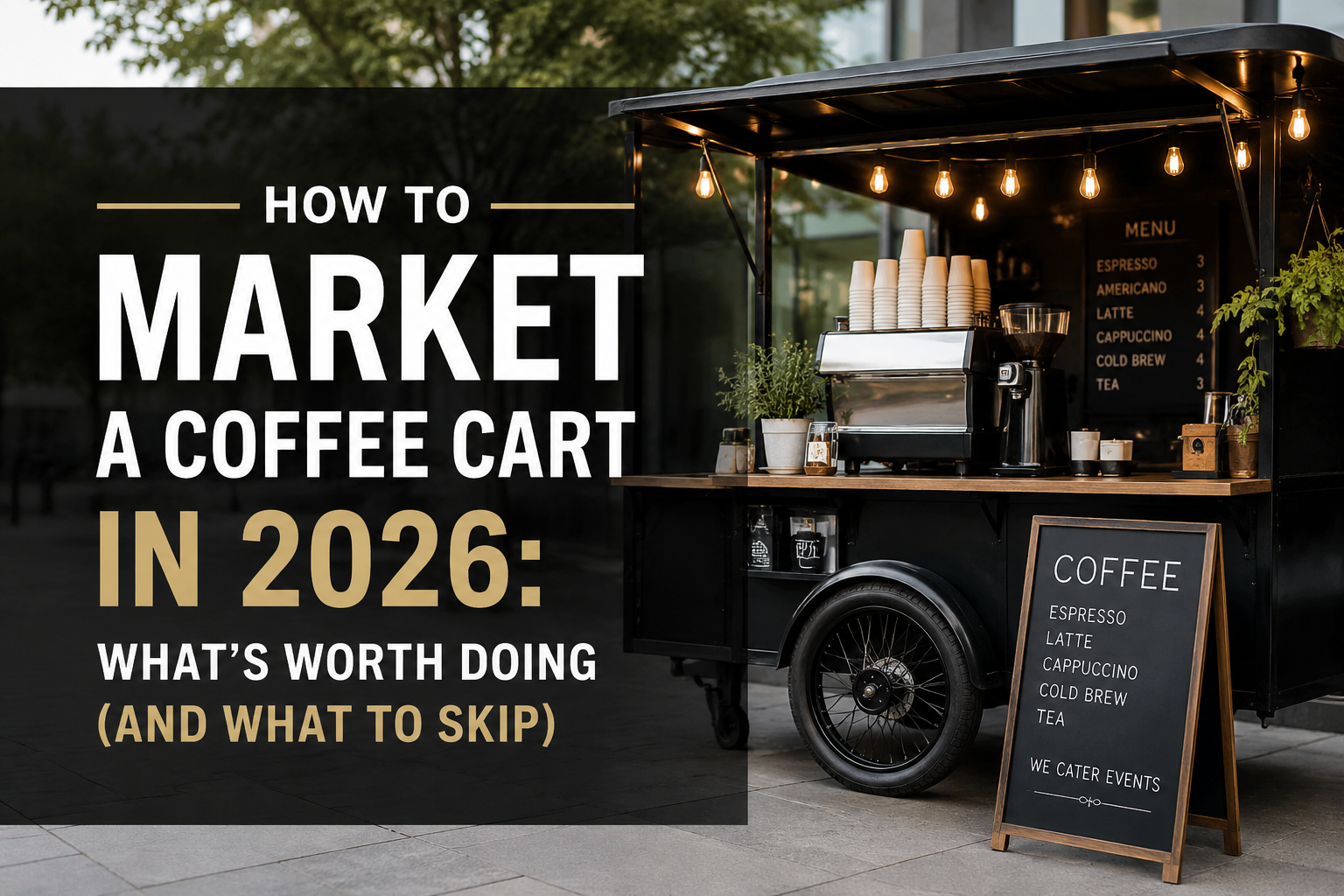
If you run a coffee cart, you do not need more marketing activity. When people ask me about How to Market a Coffee Cart, what they usually need is a simpler system that turns attention into bookings and repeat orders.
I’ve seen the same pattern across local businesses at WFpulse: the operators who grow are not the ones doing the most, but the ones measuring the right things. This guide breaks down what is actually worth doing for a coffee cart, coffee truck, or coffee trailer, and what to ignore until revenue is steady.
Start With the Only Goal That Matters: Bookings and Repeat Customers
For most coffee cart owners, the real conversion is not reach or likes. It is event catering inquiries and repeat sales, because a mobile coffee business survives on booked dates and dependable volume, not vanity metrics.
A lot of coffee shop marketing ideas sound productive but never touch revenue. More followers only matter if they turn into event leads, pre-orders, or a line at the cart during the hours you actually serve.
Set a baseline before you market anything. Track average tickets per hour, average order value, and weekly booking inquiries, because those three numbers tell you whether your marketing is creating demand, improving spend per customer, or doing nothing at all.
At WFpulse, I approach this the same way I approach local SEO and websites: Development with high-level execution means very little if the business cannot tie activity to outcomes. Combining technical Webflow expertise with results-driven business growth strategies only matters when the numbers move in a way the owner can feel in cash flow.
Pick a Simple KPI Stack You Can Track Weekly
Use a short KPI stack and review it once a week, not once a quarter.
- Primary KPIs: booking inquiries, completed bookings, calls, direction requests, online orders
- Secondary KPIs: CTR, CPC, landing page conversion rate, review velocity, returning customer rate
CTR tells you whether your message earns attention, while CPC tells you what that attention costs. A Webflow site or any other platform is only useful if those visits convert into actions you can count.
If calls are a major lead source, add call tracking so you can tie phone leads to the channel, campaign, and landing page that produced them.
Clarify Your “Where and When” Before You Market Anything
A coffee cart is a schedule business before it is a branding business. If you serve office parks on weekday mornings and private events on weekends, your marketing should reflect that exact reality instead of sounding like a generic neighborhood cafe.
If your locations change, build fast update systems. Google Business Profile posts, Instagram Stories, a site banner, and quick Instagram Reels updates work because they reduce the gap between where people expect to find you and where you actually are.
Nail Your Offer: Speed, Clarity, and Consistency Beat a Giant Menu
The strongest coffee cart marketing starts with a tight offer, not a bigger audience. Buyers usually want three things from a cart: fast service, predictable quality, and an ordering experience that does not slow down the line.
That is where menu engineering matters. A short menu with one signature drink, one seasonal feature, and one non-coffee option sells better than a long list because it reduces decision time and protects throughput during rushes.
Your offer also needs consistency across every place your business appears. NAP consistency, meaning your name, address, and phone information stay aligned across listings and citations, helps local trust and reduces confusion when customers try to find or book you.
Build a Cart-Friendly Menu That Markets Itself
A cart-friendly menu should help operations and marketing at the same time. If the menu is easy to understand from six feet away, it will usually convert better online too.
Add-ons are where many carts improve margin without adding chaos. Syrups, alternative milk, extra shots, and a small pastry set can lift average order value, but only if the workflow stays simple enough to keep the line moving.
Keep upsells simple and visible, like “add an extra shot” or “make it oat milk,” so you lift average ticket without slowing service.
Turn “We Serve Coffee” Into a Specific Promise
Specificity lowers customer friction. “Wedding espresso bar,” “2-minute lattes for conferences,” or “cold brew drop for job sites” gives people a reason to remember you and gives Google clearer on-page SEO signals about what you actually offer.
A specific promise also improves ad targeting and page relevance. If someone searches for a wedding espresso bar, a page built around that exact service will usually outperform a vague homepage talking about premium coffee for everyone.
Your Website Is Worth It (Even If You’re “Just a Cart”)
A one-page website often beats a busy social profile because it answers the questions buyers ask before they book: price, availability, setup, travel radius, and proof. Social can attract attention, but your site is where intent turns into action.
This matters even more in 2026 because AI summaries and local search results still rely heavily on crawlable pages, structured information, and clear service details. Social posts disappear fast, while a focused site keeps working when someone searches at 10 p.m. after an event planner recommends you.
Las Vegas native with deep roots, bringing hands-on experience from owning multiple local Las Vegas businesses, giving me a business-owner’s perspective on SEO and strategy.
Also, do not ignore mobile page speed, most cart customers will click from a phone and bounce if the page loads slowly.
The Minimum Viable Coffee Cart Website (5 Sections)
Your minimum site needs five sections, and each one should support brand positioning with fewer clicks.
- Hero: what you do, where you serve, and one proof point
- Offer: daily service details or pricing packages with starting prices
- Gallery: real cart, real drinks, real lines, real setup
- FAQ: power, water, timing, travel radius, deposits, menu options
- Contact: short form, service area, [YOUR PHONE NUMBER], and calendar link if you use one
A small site like this works because it respects buyer urgency. Most coffee cart prospects do not want to browse; they want to qualify you quickly.
If you cater events, add a simple booking workflow: inquiry form, availability confirmation, quote, deposit invoice, and a final details checklist.
What to Skip on the Website Until You Have Demand
Skip complex ecommerce, heavy animations, and a giant blog plan early on. If you have not validated your core offer yet, those features create cost and distraction without helping bookings.
I would also skip broad “everything we do” pages for weddings, festivals, private parties, and corporate events unless those pages have distinct offers and proof. One strong page per core service usually converts better than a bloated site trying to catch every possible customer.
Local SEO Is Worth It When You Operate in Real Places (Even If You’re Mobile)
If you serve real neighborhoods, venues, and event spaces, local SEO is one of the highest-return channels available. A coffee cart can still rank and generate leads as a service area business, even without a traditional storefront.
Google Business Profile often drives the calls, direction requests, and site visits that matter most for local operators. Local SEO and broader digital growth to drive visibility and leads works especially well for carts because searchers often have immediate intent and a short decision window.
Local SEO also compounds over time. Reviews, citations, consistent service information, and location relevance reduce your dependence on paid traffic because trust builds in the search results before someone even clicks.
Google Business Profile Setup That Actually Drives Leads
Choose the category that matches your revenue model. If most revenue comes from bookings, caterer may outperform coffee shop, and if daily walk-up traffic matters most, coffee shop may fit better.
Use keyword research to write a short description around services and areas you truly serve. Add service areas, hours, attributes, photos, and weekly posts about where you will be, what seasonal drink is live, and whether event dates are still open.
Watch the SERP for your main terms and note what Google is rewarding (map pack, photos, reviews, “near me” language, or service pages).
Reviews: The Fastest Trust Builder for Coffee Carts
Reviews do more than improve reputation. They create fresh location and service signals that help Google connect your cart to real-world demand.
Ask for reviews right after a great interaction, not days later. A QR code on the cart or a short follow-up link after an event works because review intent is highest when the experience is still fresh.
Local Pages That Make Sense for a Cart
Create a service area page and only build supporting city pages if you consistently work those locations. That structure matches search intent better than thin pages for every suburb in your region.
If events are a major revenue source, build a dedicated event espresso bar page. Ongoing Webflow support and maintenance to keep sites evolving matters here because location pages only stay useful when photos, testimonials, and service details stay current.
Google Ads Is Worth It When You Need Predictable Leads (Not “Awareness”)
Google Ads works best for high-intent searches, not broad awareness plays. If someone searches “mobile coffee cart catering” or “espresso bar for wedding,” they are already close to a buying decision.
That is why PPC can be worth it early if you need predictable lead flow while SEO matures. For a mobile coffee cart, paid search can fill the gap between having a good offer and waiting for organic visibility to build.
The Lean PPC Setup for a Coffee Cart
Start with one Search campaign per offer type. Keep event bookings separate from daily location traffic so the copy, keywords, and landing pages match what the searcher wants.
Use exact and phrase match first, and send clicks to a dedicated landing page instead of your homepage. A focused page usually converts better because it removes choices and keeps the visitor on one path.
Use geo targeting to focus spend on your true service radius and the venues you actually want, not the entire metro by default.
What to Skip in PPC at the Beginning
Skip broad match until you have enough data to control waste. Without strong negative keywords, broad match can spend money on searches from people looking for coffee beans, jobs, carts for sale, or home espresso advice.
I would also skip complex Performance Max testing early on. If your offer, tracking, and landing pages are not dialed in yet, automation just scales confusion faster.
Social Media Is Worth It for Proof and Demand Spikes—Not as Your Only Funnel
Social media is useful, but mostly as a proof engine. People want to see the cart, the drinks, the line, the setup, and the kind of events you serve before they trust you with a booking.
That is why I treat social as distribution, not the whole system. We ensure your site converts, focusing on tangible business outcomes like leads, bookings, or sales, because likes without a booking path rarely pay for labor.
If you want a deeper look at channel strategy, this breakdown on social media marketing is useful context. It supports the same point: content works better when the conversion path already exists.
A Simple Weekly Content System (30–45 Minutes)
Use one short weekly cycle.
- One behind-the-scenes clip
- One feature drink or menu post
- One location or schedule update
- One customer or testimonial moment
Prioritize short-form video because it shows speed, lines, and drink quality in seconds.
The same assets can be reused across Instagram, TikTok, Facebook, and Google Business Profile posts. Repetition helps because local buyers usually need multiple exposures before they remember where and how to book.
You can also post weekly in Facebook Groups (neighborhood groups, wedding groups, and event planner groups) as long as you follow each group’s promo rules.
What to Skip on Social Until You’re Stable
Skip daily posting if it hurts service quality. Consistency beats intensity because a coffee cart loses more money from slow operations than from missing one trend cycle.
Skip giveaways unless you can track whether they create paying customers. Engagement that attracts freebie seekers can distort your audience and waste your best content on the wrong people.
Partnerships and Real-World Distribution: The Underrated Channel
Some of the fastest coffee cart growth comes from real-world distribution, not online tactics. Vendor partnerships with wedding planners, venues, gyms, salons, coworking spaces, and office managers can create repeat demand that algorithms cannot.
A strong partner pitch should explain what you bring, what you need for setup, whether there is a revenue share, and how you make their life easier. The easier it is for a partner to refer you, the more likely they are to do it consistently.
Ask venues if they maintain a preferred vendor list and what it takes to be included.
Where to Find High-Intent Partners
Wedding venues, planners, and photographers often create repeat referral loops. Property managers, office admins, and conference organizers can drive predictable weekday volume with less seasonality than event-only models.
What to Skip With Partnerships
Skip vague “let’s collaborate” conversations. Propose a specific date, setup, offer, and expected outcome so the other side can say yes or no quickly.
Skip low-traffic pop-ups that cost labor and produce no repeat demand, no content proof, and no partner relationship. Exposure without follow-on value is usually just expensive busyness.
What’s Worth It vs What Can Wait: A Practical Priority Stack
Early on, what is worth it is simple: a conversion-focused website, Google Business Profile, a review system, and one clear offer. Those four assets create the base that makes every later channel more efficient.
What can wait is the stuff owners usually want first. Heavy branding projects, giant content calendars, and multi-platform ad tests sound ambitious, but they rarely outperform a simple system tied to real conversion data.
If you want a broader look at how local channels are shifting, this piece on las vegas digital marketing recap 2025 2026 growth predictions adds useful context. The same trend shows up across industries: businesses that build the foundation first spend less to grow later.
The 30-Day “Foundation” Checklist
- Launch a simple site and one landing page per core offer
- Set up GA4 and conversion tracking
- Optimize Google Business Profile
- Collect your first 10 reviews
- Publish weekly updates
The 60–90 Day “Scale” Checklist
- Test a lean Search campaign
- Build 2 to 5 partner relationships
- Refine packages and minimums
- Add 1 to 2 local pages if service areas are consistent
Common Coffee Cart Marketing Mistakes (and the Fix)
The most common mistake is marketing too many things at once. A huge menu, five audience types, and three unclear offers create confusion, and confused buyers do not book.
The second mistake is relying only on Instagram. Social proof matters, but if all roads lead to a profile instead of a booking page, you are asking motivated buyers to do extra work.
The third mistake is running ads before the page converts. Traffic does not fix weak messaging, missing proof, or a slow form; it just exposes those problems faster.
The “No Tracking” Problem
If you cannot measure forms, calls, and booked inquiries, you cannot judge ROI. Set up GA4, conversion events, and UTM parameters before spending money so you know which channels produce actual demand.
If you are running PPC, combine UTMs with call tracking so you can see which keywords produce real inquiries, not just clicks.
For businesses trying to sort out platform priorities, las vegas SEO vs web design what local businesses need first and what is webflow are useful supporting reads. The bigger lesson is simple: the platform matters less than whether the site is built to track and convert.
A Simple Example Plan: From Zero to Consistent Bookings
In week one and two, tighten the offer, launch a one-page site, set up Google Business Profile, and create a review QR code. That gives you a conversion hub, a discovery channel, and a trust system in one move.
In week three and four, publish proof content, reach out to 10 partners, and add one event landing page. By month two and three, run a small Search campaign for event terms and adjust based on conversion rate and cost per qualified inquiry.
Before you scale, confirm the basics: permits, insurance, minimum spend (if you require one), and a simple business plan that protects your schedule and cash flow.
This is also where on-page structure matters. If you want a practical look at local growth mechanics, what goes into a real las vegas SEO campaign 2026 guide for local growth explains the kind of work that usually compounds over time.
What “Good” Looks Like (Benchmarks to Aim For)
A high-intent landing page often converts around 2% to 8%, depending on offer strength, market, and proof. For PPC, cost per qualified inquiry matters more than cheap clicks because low CPC traffic can still be expensive if it never books.
Track profit margin by offer type (daily service vs events) so you do not scale the busiest work that pays the least.
Key Takeaways: The Marketing Stack That Pays Off
If I were building a coffee cart marketing system from scratch in 2026, I would start with a website that converts, a Google Business Profile that stays updated, and a review process that runs every week. That stack captures high-intent search, supports AI and local discovery, and gives social and ads somewhere useful to send people.
Then I would add Google Ads for the most commercial searches and use social to show proof, not to carry the whole business. Visibility Is Earned, Not Claimed is not just a tagline to me; it is the reality of local growth when every channel has to justify its place.
If You Only Do Three Things This Month
- Publish a clear booking page
- Optimize Google Business Profile
- Collect reviews every week
Those three actions create the strongest return for most carts because they improve trust, discovery, and conversion at the same time. Once that base is working, every other tactic gets easier to evaluate.
FAQ
What is the most profitable item in a coffee shop?
Brewed coffee and espresso drinks with add-ons usually carry the strongest margins. Syrups, alternative milk, and extra shots improve profit further because they add revenue faster than they add cost.
What is the 80 20 rule for coffee?
In many coffee businesses, a small group of drinks drives most sales. For a cart, that usually means about 20% of the menu creates roughly 80% of revenue, which is why trimming weak items often improves speed and profit.
This 80/20 rule is also useful for marketing: a small set of pages, keywords, and partners often drives most bookings.
What are the trends in the coffee market?
The biggest trends are speed, specialty-quality basics, seasonal drinks, non-dairy options, and pop-up style experiences. On the marketing side, Google Business Profile, reviews, and clear local intent signals matter more because discovery is getting more utility-driven.
If you want to validate coffee market trends in your area, check Google Trends and Amazon Trends for rising flavors, syrups, and ready-to-drink interest, then test one seasonal special.
Is a coffee cart a profitable business?
It can be profitable if the menu is tight, service is fast, and bookings stay consistent. Profit usually depends on location quality, labor control, ingredient costs, and whether event packages create dependable higher-ticket revenue.
Communicate pricing clearly (including any minimum spend) and use simple upsells to protect profit margin without adding more menu complexity.
Where can I get real-world advice from other cart operators?
Communities like r/coffee_roasters can be useful for equipment, workflow, and sourcing discussions, but always filter advice through your own business plan and local permits requirements.