
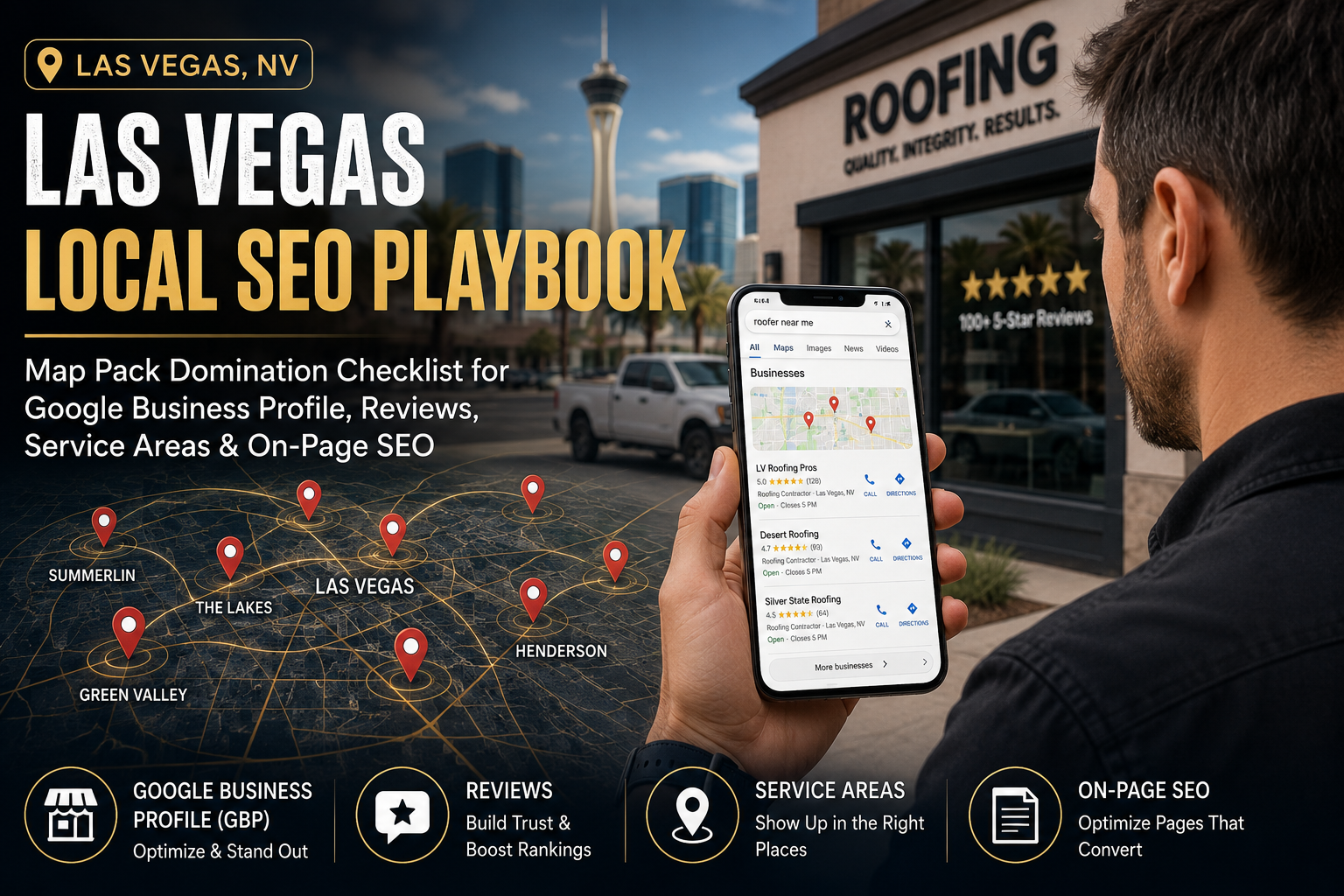
Interactive checklist
Map Pack Domination Checklist
GBP · Reviews · Service Areas · On-Page · 32 items
Checklist complete
Your profile, reputation, coverage, and on-page signals are all aligned. Time to watch those rankings move.
What "Map Pack Domination" Actually Means (And Why It Pays)
The Google Local Pack, often called the Map Pack, is the map-based block of local business listings that appears for searches like "roofer near me" or "Las Vegas med spa." It is different from standard organic results because Google is trying to satisfy immediate local intent, not just deliver informational pages.
That difference matters because Maps traffic often comes from people with immediate local intent compared to many informational organic clicks. A user who taps call, requests directions, or books from a Google Business Profile is often closer to a transaction than someone reading a blog post.
Map Pack domination is not about ranking once for one vanity term. It means earning consistent top-three visibility across the priority searches that bring revenue, which is why I treat it as an operational goal rather than a single SEO trick.
Google has said local rankings are shaped by relevance (fit to the query), distance (proximity), and prominence (reputation), and that framework still explains many outcomes. Link building still matters, but only as one part of a larger system that also includes categories, reviews, localized trust signals, and conversion-ready pages.
I look at this through the lens of pairing strong site execution with business growth strategy. Visibility is earned, not claimed, and local rankings improve fastest when your profile, your website, and your customer proof all point to the same services and the same market.
How the Local Algorithm Chooses Winners
Relevance is Google's way of asking whether your business is actually a fit for the search. If your GBP category says "personal injury attorney" but the search is for "DUI lawyer," your listing may lose to a firm whose categories, services, and localized content match that need more closely.
Distance is exactly what it sounds like: how close your business is to the searcher or the place named in the query. You cannot SEO your way into being physically closer, but you can engineer better coverage by building content and service pages around the areas you truly serve.
Prominence is the reputation layer, and this is where many businesses either win or disappear. Reviews, citations, links, press mentions, and a trusted site all tell Google that your business is known, active, and worth surfacing.
In competitive categories here, the businesses that win usually combine clear positioning, consistent proof, and a site that loads fast and answers real intent. A beautiful design is not a strategy if it does not support trust and conversion.
The most overlooked piece is conversion. I focus on improving leads, bookings, or sales because better user satisfaction and engagement can support local performance over time — and it makes the traffic you earn worth more.
The 80/20 of Map Pack Growth
Most local businesses do not need fifty tactics. The 80/20 is simple: get your primary GBP category right, improve review velocity and review quality, and make your core pages match the exact services and locations people search.
Small consistency fixes often create outsized movement because local SEO is sensitive to trust gaps. Wrong hours, mismatched NAP, weak categories, and missing GBP products or services can suppress performance even when the business itself is strong.
Baseline Setup: Fix the Foundations Before You "Optimize"
Before I touch advanced tactics, I check ownership, verification, and duplicates inside Google Business Profile. Google Business Profile verification is the gatekeeper because an unverified or unstable listing cannot build reliable local authority.
Duplicate listings are one of the most common hidden problems I find. They split ranking signals, confuse customers, and can trigger ranking instability that people mistakenly blame on the algorithm.
Your name, address, and phone number need to match across your website, citations, and real-world signage. NAP consistency is not glamorous, but it is one of the clearest trust signals Google can compare across sources.
I also audit the primary conversion paths before changing anything. If call tracking is set up badly, you can hurt NAP consistency and lower conversion rate visibility at the same time.
At this stage, I also run a quick technical SEO sweep: indexability, mobile usability, page speed, broken links, and whether key pages are blocked by accident. These issues do not look "local," but they can quietly cap performance.
A simple KPI dashboard keeps local SEO tied to revenue. Track GBP impressions, actions, calls, direction requests, bookings, and the website metrics that show whether your website structure supports actual lead flow.
Quick Audit Checklist (30 Minutes)
In a fast audit, I check business name compliance, business categories, hours, service areas, and attributes first. Those fields directly shape relevance and trust, so errors there can suppress performance before content even enters the picture.
Next, I scan for duplicate listings, wrong map pins, and outdated holiday hours. These are small errors with big consequences because they create friction for users and weaken Google's confidence in the listing.
Tracking Without Breaking Local SEO
The safest call-tracking setup uses one consistent primary number for GBP and citations, then uses tracking numbers only where needed — for example, via dynamic number insertion on your website — without replacing the canonical business number everywhere. This approach preserves local trust while still letting you attribute leads.
I also add UTM parameters to GBP website, appointment, and product links. That single step makes Google Analytics far more useful because it separates Maps traffic from other channels instead of hiding local performance inside direct or organic buckets.
Google Business Profile Optimization: The Non-Negotiables
Your primary category is one of the strongest relevance signals in local SEO, so I choose it based on the main revenue service and the actual SERP pattern in your market. Secondary categories matter too, but they should support the core offer rather than dilute it.
The business description should mirror real search intent and business outcomes. A good description explains what you do, who you help, and where you serve, while homepage optimization and service-page alignment reinforce the same message on your site.
More complete profiles usually convert better because they reduce uncertainty — start with accurate hours, the right categories, services, photos, and a clear call/booking path. That means filling out GBP products, services, attributes, booking links, and business details that help a customer decide without leaving Google.
Photos are not decoration in a competitive market like Las Vegas. Exterior shots, interior shots, team photos, work examples, and before-and-after images function as legitimacy proof, which is why strong visual evidence often correlates with better engagement.
Categories, Services, and Attributes That Move Rankings
Primary category selection deserves more attention than most businesses give it. I would rather see one accurate primary category and a few tightly matched secondary categories than a long list of loosely related options.
Map each service to GBP services and then align those entries with matching sections or pages on the site. That one-to-one structure helps Google understand relevance and helps users confirm that the listing and website describe the same business.
GBP Activity Signals: Posts, Q&A, and Updates
GBP Posts are useful when they communicate proof, offers, seasonal demand, or operational updates. They are not a direct ranking shortcut, but they can improve engagement signals and keep the profile active.
Q&A is one of the best places to address objections before they cost you a lead. I like to seed common questions about pricing, turnaround time, licensing, and service coverage because those are the exact details that influence local conversion decisions.
Reviews Engine: Quantity, Quality, Velocity, and Responses
Reviews are not just social proof. In local SEO, they act as a live feed of market validation, and Google uses that pattern to evaluate prominence and customer satisfaction.
The best review system is tied to your workflow, not left to chance. Ask at the moment value is delivered, whether that is after a completed repair, a successful appointment, or a finished project.
I coach clients to encourage natural detail, not scripts. When customers mention the service type, result, and neighborhood on their own, Google gets stronger contextual signals and future customers get more believable proof.
Review replies matter too. Consistent, human review responses help future customers feel taken care of, and they reduce the damage when a negative review is the first thing someone reads.
Review Request Playbook (That Stays Compliant)
Use SMS or email with a single direct review link and ask while the positive experience is still fresh. Convenience increases completion rates more than fancy wording ever will.
Avoid gated reviews and incentives because both create compliance risk and distort your reputation profile. A steady, honest review velocity is more durable than short bursts of manufactured positivity.
Response Templates That Improve Conversions
For positive reviews, mention the service, reflect the outcome, and invite the next conversation naturally. A reply like that adds relevance without sounding robotic, which is critical because canned responses can weaken trust.
For one- to three-star reviews, respond quickly, stay factual, and show a clear resolution path. Prospective customers judge your business by how you handle friction, not by whether friction ever happens.
Service Areas Done Right: Coverage Without Thin Content
A service-area business, or SAB, is different from a storefront in how Google expects location signals to appear. A storefront benefits from a physical address and walk-in relevance, while a service-area business has to prove coverage and credibility through service areas, content, and customer proof.
I define service areas based on where the business can actually fulfill jobs profitably and consistently. That matters because broad coverage claims often create weak rankings everywhere instead of strong rankings in the places that count.
Location and service pages only make sense when you can add unique substance. Thin city pages with swapped place names often look like near-duplicate, low-value pages, and Google has gotten better at discounting that pattern unless the page has real unique proof and local specifics.
Service-Area Strategy for SABs
Use GBP service areas to communicate coverage, but do not expect that field alone to make you rank in every suburb. On-page relevance still does the heavy lifting, especially for competitive terms.
I only build "service x area" pages where there are real jobs, original photos, testimonials, and local FAQs to support them. That approach creates pages that can rank and convert instead of bloating the site with weak URLs.
Location Page Quality Checklist
A good local page has a unique intro, specific services, proof, pricing ranges when appropriate, and FAQs tied to that area. Those elements make the page useful to both searchers and Google, which is the real threshold for local visibility.
Embed a map only when it helps the user. Repeating geo terms unnaturally is not local SEO; it is a readability problem that often signals low-quality intent.
On-Page Local SEO: Make Your Website Reinforce the GBP
Your homepage and core service pages should answer three questions fast: who you are, what you do, and where you serve. When those answers are vague, your GBP and website stop reinforcing each other.
I add local intent modifiers naturally in titles, H2s, body copy, and FAQs, but every page still needs one primary purpose. A page trying to rank for five services and ten cities usually becomes irrelevant for all of them.
Internal linking is one of the easiest wins in local SEO because it helps Google understand your service hierarchy. Homepage to service pages to supporting content to contact is a simple path that strengthens relevance and user flow at the same time.
Trust blocks matter more than many businesses realize. Licensing, insurance, guarantees, awards, and real project photos reduce hesitation, which helps rankings indirectly by improving engagement and conversion behavior.
Site Structure That Supports Map Pack Rankings
A clear service taxonomy keeps authority concentrated instead of fragmented. Orphan pages, overlapping services, and messy navigation make it harder for Google to understand what the business actually specializes in.
Consistent breadcrumbs and navigation support that same clarity. If your website structure is clean, your local landing pages inherit stronger topical context and are easier for users to navigate.
Local SEO Page Elements Checklist
Every important page needs a focused title tag, a clear H1, supportive H2s, and FAQs aligned to one local intent. Schema markup should support that structure, with LocalBusiness (or Organization) on your main business/contact page and location pages where applicable, and HowTo schema only where instructional content genuinely fits.
If you publish an FAQ section, consider adding FAQPage schema so search engines can understand the question-and-answer structure. Keep it honest and concise, and only mark up questions that are visible on the page.
Your footer and contact page should match GBP NAP exactly, and mobile users should see a click-to-call option immediately. That alignment turns the site into a confirmation layer for the listing instead of a source of conflicting data.
Authority Signals: Citations, Links, and Local Proof
Citations still matter in 2026, but quality beats quantity by a wide margin. I would rather fix a handful of wrong listings on major platforms than build dozens of weak directory mentions.
Local backlinks remain one of the strongest prominence signals because they connect your business to the real local ecosystem. Chambers, suppliers, sponsorships, neighborhood organizations, and niche associations all send stronger trust signals than generic link schemes.
If you are not sure where to start, your local chamber of commerce is often a clean first win: it is a real-world entity, it usually comes with a directory listing, and it aligns with how legitimate businesses participate in a city.
Real-world proof is the bridge between rankings and revenue. Case studies, project galleries, and testimonials tied to specific services make your authority visible instead of implied.
For multi-location brands, consistency has to coexist with local specificity. Templates can standardize layout, but each location needs unique proof and localized context to avoid thin, interchangeable pages.
Citations: What Matters in 2026
Consistency beats volume because Google compares business data across sources. Wrong categories, duplicate profiles, and outdated addresses create ambiguity that weakens prominence.
I prioritize primary data aggregators, top-tier directories, and industry-specific listings before anything else. That order gives you the highest trust return for the least cleanup effort.
Local Link Ideas That Don't Feel Spammy
Supplier pages, vendor lists, local event pages, scholarships, and community features are practical local backlink sources. They work because they reflect real relationships, not manufactured SEO footprints.
When pitching local stories, lead with outcomes. A completed project, community contribution, or measurable result gives publishers a reason to mention you that goes beyond "we exist."
Common Mistakes That Kill Map Pack Momentum
Keyword-stuffing the business name is still one of the fastest ways to create suspension risk. It may produce a short-term bump, but the downside is severe enough that I never treat it as a legitimate tactic.
Thin service-area pages are another common failure point. They dilute trust, create cannibalization, and make the site look larger without making it stronger.
Ignoring reviews is expensive because silence becomes part of your brand perception. Unanswered negative reviews can suppress conversions long before they show up as a ranking problem.
Mismatched NAP, wrong map pins, and inconsistent hours create what I call death by a thousand cuts. None of them looks dramatic alone, but together they erode both trust and performance.
Suspension and Reinstatement Risk Factors
Name, address, and category violations are common triggers for suspensions. If Google sees conflicts between your listing, signage, website, and citations, it may question whether the business is represented accurately.
Business suspension risk goes up when edits happen too fast, ownership is unclear, or the listing conflicts with what customers see in the real world. If you need changes, make them cleanly, document them, and avoid creative naming.
Document legitimacy before problems happen. Photos of signage, utility bills, and a citation trail that matches your listing make reinstatement much easier if you ever need it.
When "More Content" Makes You Rank Worse
Duplicate location pages often compete with each other instead of expanding reach. That cannibalization weakens the site's message and makes it harder for Google to decide which page deserves visibility.
Publishing without proof also hurts. If pages lack photos, reviews, examples, and local detail, they send weak E-E-A-T signals and rarely support Map Pack growth.
90-Day Execution Plan and Ongoing Maintenance
In weeks one and two, I fix GBP fundamentals, NAP consistency, duplicate issues, and baseline tracking. That foundation gives later content and review work a stable base to build on.
In weeks three through six, I upgrade core service pages, add FAQs and schema, and launch the review request system. This is where relevance and conversion alignment usually start producing visible movement.
In weeks seven through ten, I clean up citations, pursue local links, and publish a few supporting pieces — case studies, project spotlights, or local FAQs — that strengthen service and area relevance without creating thin content. If you want a broader view of how this fits into a market strategy, I have covered that in what goes into a real Las Vegas SEO campaign — 2026 guide for local growth.
In weeks eleven through thirteen, I iterate based on query data, GBP insights, and conversion results. Ongoing support and maintenance to keep sites evolving matters here because local SEO gains are easier to hold when the site stays updated and usable.
Scorecard: What to Measure Monthly
For GBP, track searches, views, actions, calls, direction requests, and bookings. Those metrics show whether visibility is improving and whether that visibility is turning into local intent actions.
For the website, track conversions on local landing pages and CTR from branded and non-branded queries. Those numbers tell you whether your visibility is expanding beyond people who already know your name.
How We'd Run This as a System (Not Random Tactics)
I assign one owner to each KPI area: visibility, reputation, content, and conversion. Clear ownership prevents local SEO from becoming a pile of half-finished tasks with no accountability.
The monthly cycle is simple: fix, publish, prove. That means technical cleanup, new proof assets, and new internal links — the same discipline behind related topics I have covered on how Las Vegas drug lawyers can win in AI-driven local search, how to choose the right Las Vegas SEO services, Las Vegas SEO vs web design — what local businesses need first, and our broader Las Vegas market perspective.