
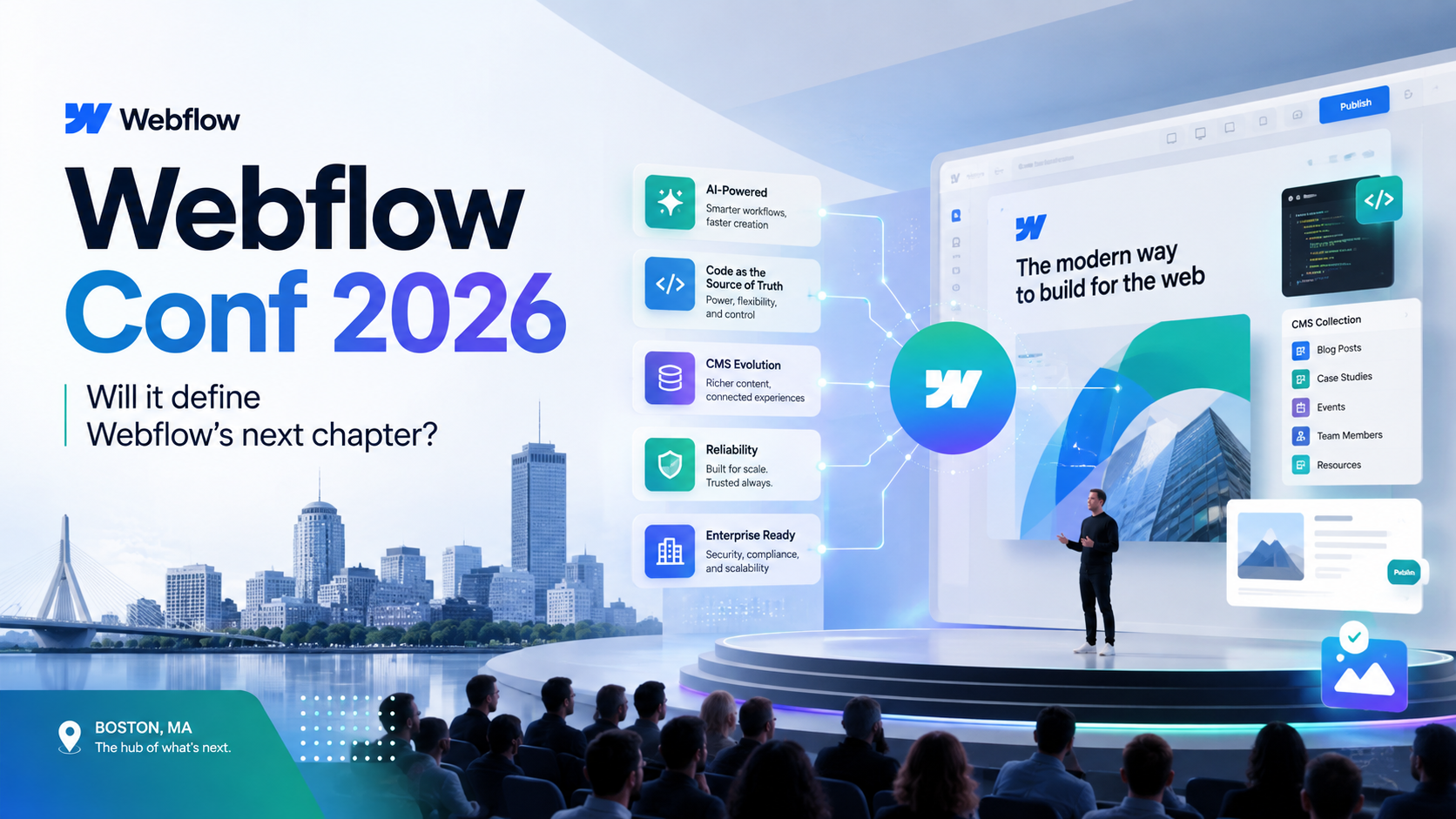
Webflow Conf 2026 has a bigger job than unveiling another round of features. For the designers, developers, marketers, and operators who have built real businesses on the platform, this is the moment Webflow needs to show where it is going, what it is willing to commit to, and how it plans to support the teams already responsible for keeping production sites running.
The question is not whether Webflow will announce something new. It almost certainly will. The real question is whether the company will finally be transparent about the product roadmap, platform reliability, AI direction, CMS limitations, and the promises it has made to the people building their businesses around Webflow.
Is Webflow Conf 2026 the conference that strengthens confidence in Webflow, or the one that exposes the gap between ambitious announcements and the day-to-day needs of serious teams?
What Webflow needs to answer at Conf 2026
Webflow Conf is Webflow’s flagship event for designers, developers, marketers, agencies, and web teams. The 2026 edition is planned for Boston and online, with Webflow Conf 2026 details indicating that 1,500 builders will gather in Boston.
That scale makes the conference more than a product showcase. It is a public test of whether Webflow understands the stakes for companies that have standardized on its platform. Those teams do not just need inspiration. They need clarity they can use to make architecture, staffing, budget, workflow, and vendor-risk decisions.
The most useful conference outcome would be a candid answer to five questions:
- How will AI-assisted workflows and MCP fit into accountable production processes?
- What is changing in the CMS for teams managing complex, high-volume, or highly structured content?
- How is Webflow improving reliability, governance, and enterprise readiness as more business-critical work moves onto the platform?
- What should customers expect from pricing and product packaging as the platform expands?
- Which parts of the roadmap are committed, which are experimental, and what should agencies and in-house teams plan around now?
Webflow does not need to reveal every future release or guarantee dates it cannot responsibly promise. But teams investing their sites, workflows, and marketing operations in the platform deserve a clearer view of what is available today, what is being built, what remains constrained, and what support looks like as capabilities move from demo to production.
Code as the source of truth raises the stakes
Webflow has already given attendees a major clue about the direction it intends to unveil. In its recent article, Getting to the source, the company says it is rebuilding Webflow around code as the source of truth and plans to show the next chapter at Webflow Conf.
That is more consequential than a typical feature launch. Webflow describes a future in which the visual canvas, code, and AI-assisted work all operate on the same canonical artifact. It also connects that direction to MCP governance, branching, permission enforcement, AI Code Components, and a next-generation headless CMS with content delivery APIs.
The opportunity is clear: a more direct relationship between what teams design, what agents and developers change, and what ultimately ships. The hard part is execution. Rebuilding a production platform around a different architectural model creates questions that Webflow Conf should address directly: how existing sites are protected, how teams transition safely, how code ownership and portability work in practice, and how governance holds up when designers, marketers, developers, agencies, and AI agents all touch the same system.
Are product announcements turning into production-ready tools?
Launch-stage excitement is not the same as operational readiness. A new capability becomes valuable only when a team can use it repeatedly without creating new quality, governance, or maintenance problems.
That is the standard Webflow should meet at Conf 2026. Rather than only showing what a tool can generate in a controlled demo, Webflow should show how it works in the conditions that matter after launch: stable releases, usable documentation, clear permissions, branching, rollback options, regression testing, performance safeguards, support, and an understandable recovery path when something fails.
This is especially important for AI-assisted workflows. Webflow says more than 30% of its enterprise customers are already running agents against production Webflow sites through MCP, and that adoption has increased roughly fourfold since January. That makes governance, permission enforcement, human review, design-system consistency, accessibility, SEO, and change control central questions, not edge cases.
AI in web design can reduce repetitive work and help teams move faster. It can also create inconsistent components, fragile code, weak information architecture, inaccurate content, and unclear ownership when it is used without guardrails. The right question is not whether Webflow AI is impressive. It is whether it helps teams build more reliable, findable, conversion-focused sites without shifting hidden risk onto the people responsible for maintaining them.
The CMS and content-scale question has not gone away
The CMS remains central to Webflow’s value proposition and central to many of its most consequential constraints. As teams scale, their concern shifts from whether they can publish a page to whether they can model content cleanly, manage relationships, govern permissions, support localization, reuse content, and make structural changes without damaging search visibility or conversion paths.
Webflow’s code-as-source-of-truth direction and reference to a next-generation headless CMS with content delivery APIs make this an essential Conf 2026 topic. Teams need a clearer view of what Webflow sees as the future of complex content operations, integrations, editorial workflows, structured data, high-volume publishing, and the practical limitations that still require a different approach.
A serious CMS conversation must include maintenance. A content model is not successful merely because it works at launch. It succeeds when a team can update it months later without breaking templates, generating duplicate pages, losing internal links, or creating technical debt that undermines SEO.
Reliability and enterprise readiness are part of the product story
For a marketing site, a broken form or publishing problem can mean lost leads. For a business operating multiple Webflow properties, a platform issue can affect campaigns, sales operations, support, recruiting, and customer trust.
Reliability therefore belongs alongside AI and visual development as a first-class conference topic. Teams need confidence in incident communication, release management, recovery expectations, access roles, domain and DNS dependencies, form reliability, redirects, change logs, Core Web Vitals, and the operational protections available when a live site is affected.
Webflow should also be explicit about what customers can manage natively, where custom code or third-party tooling remains necessary, and when experienced agency support is still the sensible answer. Clarity about those boundaries would build more confidence than an implication that every workflow is already solved.
The promises Webflow needs to keep
This is not an argument that Webflow has broken a specific promise. It is an argument that the company should meet the higher communication standard its ambitions now require.
Webflow does not need to reveal every future release. But the teams investing in the platform deserve a clearer picture of what is committed, what is experimental, and what support looks like when new capabilities move from demo to production.
For agencies and in-house teams, roadmap ambiguity creates real costs. It can delay a rebuild, complicate a CMS decision, force an unnecessary workaround, or make a team hesitate before investing in a component system or integration that may soon change. Clearer commitments will not eliminate platform risk, but they will make it manageable.
What this means for businesses running Webflow sites
The conference matters because platform changes become operational work for the businesses running Webflow sites. Every new AI workflow, CMS capability, component model, integration, or publishing control has to be evaluated against the systems already in place.
For business owners and marketing teams, that means protecting the fundamentals while the platform evolves: SEO, CMS structure, site speed, forms, analytics, integrations, conversion paths, permissions, redirects, and ongoing maintenance. The objective is not to adopt every announcement. It is to identify which changes solve a real constraint and can be implemented safely.
At WFpulse, we evaluate Webflow through operational impact, not feature novelty. A capability is worthwhile when it improves publishing, governance, performance, search visibility, or measurable business outcomes without adding hidden maintenance costs.
If your site runs on Webflow, conference news is only useful if your team can turn it into a safer, faster, more effective website. WFpulse helps businesses manage Webflow changes without sacrificing rankings, performance, or conversion paths.
Boston or online: attend with a purpose
The conference is scheduled for September 1 through September 3, 2026, at the Omni Boston Hotel at the Seaport in Boston. A parallel online stream broadens access, but attendees should verify current ticket availability, session access, and streaming terms on Webflow’s official event page before making commitments.
Boston attendance may be worthwhile for teams that need direct conversations with peers, partners, and Webflow representatives. Online participation is a practical option for people who primarily need the keynote, selected sessions, and recordings. According to the Webflow Conf FAQ, online access is free and includes the live keynote, select sessions, and on-demand recordings.
Research comparing conference formats finds that in-person events can be stronger for networking and community, while virtual participation increases access at a lower cost. The right format depends on whether the team needs relationship-building, first-hand answers, or simply a disciplined way to evaluate the announcements.
How to judge Webflow Conf 2026 after the keynote
Do not judge the conference by applause, production value, or the number of features announced. Judge it by whether Webflow gives teams a more reliable basis for decisions they must make after the event.
A strong conference would leave attendees with clearer answers to these questions:
- Can we build our next phase on Webflow with confidence?
- What platform limitations should we design around today?
- Which upcoming changes are concrete enough to influence our roadmap?
- How does Webflow AI improve our workflow without weakening quality control?
- How will code as the source of truth affect the sites, workflows, and teams we already operate?
- What operational protections do we have when a site, form, integration, or publishing workflow fails?
- Where should we invest in internal capability, external support, or a different technical approach?
The conference could define Webflow’s next chapter
Webflow Conf 2026 can strengthen confidence if it treats its audience as the owners of real production systems rather than simply the audience for a launch event. That means clear commitments, honest limitations, dependable infrastructure, a practical AI strategy, and a roadmap narrative that respects the consequences of platform decisions.
Webflow’s stated move toward code as the source of truth gives the conference genuine significance. If it can explain how that direction will be delivered responsibly for existing customers and production teams, Conf 2026 could mark a more mature next chapter for the platform. If it relies mainly on ambitious announcements without operational detail, it may sharpen the concern that Webflow’s vision is moving faster than the teams expected to depend on it.
For anyone attending, the goal should be simple: leave with evidence, not just excitement. Turn each announcement into a decision about architecture, workflow, maintenance, SEO, and business impact, then assign an owner and a next step before the momentum fades.